
Packaging Reuse and Refill in Africa: Lessons for South African EPR Producers
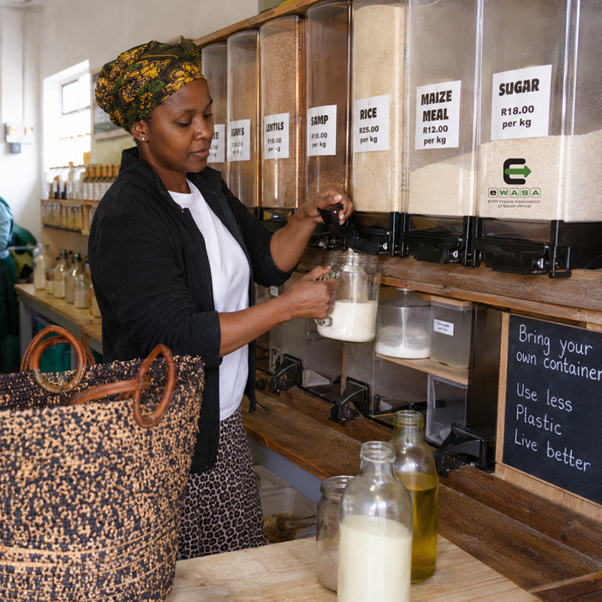
In Diepsloot, Johannesburg, shoppers at the Skubu refill store can buy maize meal, cooking oil, sugar, rice and household products without paying for single-use packaging. They bring their own containers, refill only what they need, and in some cases save 50- 60% compared with conventional packaged goods.
For South African producers, this is more than a township retail innovation. It is a commercial signal. As Extended Producer Responsibility continues to mature in South Africa, packaging reuse and refill schemes are becoming part of the conversation on compliance, cost management and circularity.
Reuse and Refill Are Rising Up the Agenda
Africa’s packaging waste challenge is urgent. Around 85% of municipal solid waste disposal in sub-Saharan Africa is uncontrolled, which means much of the packaging placed on the market is not recovered through formal systems. Single-use plastic packaging, sachets, bottles and multilayer formats are especially difficult to collect and process at scale.
The reusable packaging market in Africa is projected to grow strongly toward 2031, driven by food and beverage, retail and manufacturing demand. This growth aligns with global movement toward EPR schemes that shift responsibility for product end-of-life management back to producers.
Africa also has a practical foundation for reuse. Water refill stations, milk ATMs, oil refill points and returnable beverage bottles are familiar in many communities. These models are not imported ideas; they build on existing consumer behaviour.
What has changed is the regulatory pressure. South Africa and Kenya now have mandatory packaging EPR frameworks, while countries such as Egypt, Rwanda, Nigeria, Ethiopia and Ghana are moving toward stricter rules on plastic packaging, single-use items and producer accountability. East African Community packaging standards are also beginning to create more alignment across regional markets.
For producers, this means that packaging reuse strategies need to be assessed as part of compliance planning, not only as corporate social responsibility.
Four African Reuse and Refill Models Worth Watching
Skubu: Diepsloot, South Africa
Skubu is one of the most relevant refill schemes South Africa has produced so far because it connects affordability, packaging reduction and community retail in one model.
The store uses automated dispensers for everyday staples and household goods. Customers bring containers, choose the quantity they can afford, and pay by weight or volume. This removes the cost of individual packaging and gives low-income households more control over spending.
Research linked to the model indicates that Skubu can eliminate up to 100% of single-use packaging for participating product lines and deliver consumer savings of 50-60%. Unilever brands such as Sunlight and Handy Andy have also been made available through refill dispensers, showing that large FMCG producers can participate in community refill without giving up brand presence.
The producer lesson is direct. Refill stores can become viable distribution channels. They can reduce packaging costs, improve market access and support reusable packaging EPR compliance when the right reporting systems are in place.
Gcwalisa: Alexandra, South Africa
Gcwalisa is a township-based refill retail model operating from shipping-container outlets in Alexandra, Johannesburg. Founded by Miles Kubheka in 2022, the project uses bulk dispensers and a “weigh and pay” system that allows residents to buy everyday food and household products in the quantities they can afford, without paying for unnecessary single-use packaging. By sourcing directly from manufacturers and selling at near-wholesale prices, Gcwalisa addresses two pressures at once: reducing packaging waste and making essential goods more affordable for low-income households. For producers, the model shows how community refill retail can become a practical bulk distribution channel while supporting circular packaging and EPR objectives.
EcoCAN: Kenya (Digital Deposit-Return)
EcoCAN in Kenya shows how deposit-return systems can work without expensive reverse vending machine infrastructure. The model uses a digital platform for glass beverage packaging. Consumers scan containers, return empties to an EcoCAN agent, and receive refunds through mobile money systems such as M-Pesa.
This matters for South Africa because discussions about deposit return schemes often focus on infrastructure costs and complex logistical realities. EcoCAN shows that mobile technology, agent networks and digital tracking can reduce those barriers.
For beverage producers, this creates a useful scenario-planning example. If deposit-return requirements expand in South Africa, producers will need systems that verify container return, prevent fraud, manage deposits and report collection performance. Digital DRS models can support those functions.
It also links directly to paper and packaging EPR, where producers need to consider how packaging formats perform across collection, reuse, recycling and reporting pathways.
Silafrica: East Africa (B2B Returnable Crates)
Not all reuse models depend on changing household shopping behaviour. Silafrica’s work in East Africa focuses on B2B reusable packaging, including returnable plastic crates that replace single-use cartons in supply chains.
The opportunity is significant. One-way paper carton packaging contributes large volumes of landfill waste across the region. Silafrica estimates that 160 000 tonnes of paper packaging waste from one-way cartons is sent to landfill annually in parts of East Africa.
Returnable crates can reduce this waste while improving total cost of ownership for producers, distributors and retailers. They are durable, trackable and designed for repeated use.
For producers looking for measurable performance gains, B2B reuse may be the fastest route. It avoids some consumer adoption barriers and can be integrated into existing logistics contracts, warehousing systems and product movement data.
What South Africa’s EPR Framework Already Incentivises
South Africa’s packaging EPR South Africa framework already contains signals that favour reuse, even where plastic reuse targets are still limited.
Glass packaging has reuse targets, and the 2024 EPR Fees Guideline recognises Deposit Refund Scheme structures as a product take-back mechanism. This creates a policy basis for returnable packaging and DRS models, particularly in the beverage sector.
The Draft National Waste Management Strategy 2026 goes further by treating waste “prepared for reuse” as a distinct monthly reporting metric. That is important because it separates reuse from recycling. Producers that can measure reuse accurately will be better positioned as reporting expectations become more detailed.
Eco-modulated fees also matter. Packaging that is easier to reuse, repair, recycle or recover can attract more favourable treatment than formats that are difficult to manage after use. Producers reviewing EPR fees for packaging producers should therefore assess design choices through a reuse lens.
This is where sustainable packaging and the broader circular economy in South Africa intersect. Reuse moves packaging higher up the waste hierarchy because it prevents waste before recycling is needed.
Voluntary commitments reinforce this direction. The SA Plastics Pact includes major retailers and producers working toward packaging that is reusable, recyclable or compostable. While voluntary commitments do not replace legal obligations, they shape market expectations and procurement decisions.
Four Practical Steps Producers Can Take Now
- Audit packaging for refill-readiness.
Start with the packaging portfolio. Identify which formats could be standardised, made more durable, supplied in bulk, or redesigned for return and refill. Producers can use resources on types of packaging and how to recycle them as a starting point for understanding material recovery pathways, then go further by asking whether packaging can be reused before it becomes waste. - Explore bulk supply to community refill retailers.
Models such as Skubu and Gcwalisa show that township refill stores can serve households that are often priced out of larger pack sizes. Bulk supply to these outlets can reduce packaging inputs while maintaining product access. Producers should assess which product categories are suitable for dispensers, including dry goods, detergents, cooking oils and cleaning products. - Design EPR reporting to capture reuse data now
Waiting for new reporting rules creates avoidable risk. Producers should begin tracking refill volumes, container cycles, return rates and avoided single-use packaging. This aligns with the 5Rs framework, where refuse, reduce, reuse, repurpose and recycle support a stronger circular packaging strategy. - Monitor DRS policy developments.
South Africa does not yet have a mandatory national plastic beverage container DRS, but policy discussions are active. Beverage producers should scenario-plan for deposit values, return points, logistics partners, fraud controls and consumer communication. Early planning will reduce disruption if DRS compliance becomes mandatory.
The Barriers Are Real
Reuse and refill schemes still face practical constraints. South Africa has glass reuse targets, but no binding plastic reuse targets at the same level. That weakens the business case for some producers because recycling remains the primary compliance focus.
Upfront cost is another barrier. Refill infrastructure requires dispensers, bulk handling systems, cleaning protocols, durable containers, digital tracking and staff training. SMEs may struggle to fund these investments without grants, partnerships or producer support.
Food safety standards also need careful management. Open refill systems must protect product quality, especially for food and personal care products. Standard operating procedures, hygiene controls and clear accountability are non-negotiable.
Even so, the barriers are shrinking. GIZ SWITCH-2-CE grants, SACiLa case studies and circular packaging research are helping build the evidence base. Development finance and public-private partnerships are also making pilots more accessible.
There is another important link in the value chain: refurbishment and second-life use. Producers considering reuse should also understand how refurbishers support EPR, because circular systems often depend on repair, cleaning, quality control and redistribution.
The direction is not frictionless, but it is practical. Reuse is moving from isolated pilots toward tested infrastructure.
What This Means for Your EPR Strategy
The direction of travel is clear. EPR will increasingly reward producers who prevent packaging waste, not only those who recycle it after use.
For South African producers, refill and reuse should now sit inside packaging strategy, EPR compliance planning and product design. Community refill stores show how reuse can reduce costs for consumers. Digital deposit-return models show how take-back systems can work in African markets. B2B returnable crates show that measurable reuse performance can start inside supply chains.
Producers that act early will be better prepared for eco-modulated fees, future reuse reporting and possible DRS requirements. They will also be better placed to reduce material costs, support circular packaging objectives and respond to consumer pressure for single-use plastic alternatives.
eWASA tracks these developments for members and supports producers working toward practical, compliant circularity. To strengthen your packaging strategy, review how your organisation can reduce packaging waste and prepare for the next phase of reusable packaging EPR compliance.

