
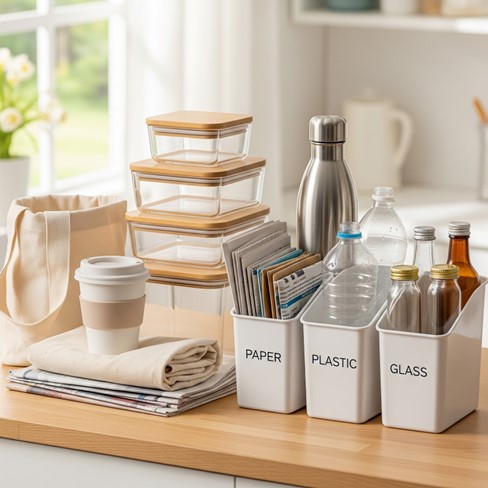
Simple Swaps to Reduce Packaging Waste at Home
Packaging protects products and enables efficient distribution, but much of it is designed for single use. When households treat packaging as disposable by default, the result is higher landfill pressure, litter leakage, and lost resources that could have been recovered.
Nine simple swaps to reduce household packaging
1) Bar soap instead of bottled soap
Switching a frequently used liquid soap to a paper-wrapped bar reduces repeat purchases of plastic bottles and pumps. Where bars are not practical, consider refills, and treat refills as packaging that must still be sorted correctly.
2) Concentrates and refills for cleaners
Many cleaners are largely water shipped in new containers. Concentrates and refills reduce packaging per use. Keep one durable bottle, refill it, and rinse and dry empties so they do not contaminate other recyclables.
3) Loose produce plus reusable produce bags
Thin produce bags and plastic-wrapped produce add up quickly. Keep reusable produce bags where you will remember them, choose loose items when available, and avoid double-bagging at checkout to reduce the amount of packaging entering your home.
4) Reusable containers instead of cling film
Cling film and mixed-material wraps are typically used once and discarded, often with food contamination that limits recovery. Standardise on stackable containers and reusable covers to prevent waste at source and improve food storage.
5) One reusable bottle and cup as your default
Single-use bottles and cups are high-volume items. Carry a reusable bottle and, where feasible, a reusable cup. If you do buy a single-use bottle, empty, rinse, and place it in the correct stream to support plastic recycling performance.
6) Fewer, larger packs (selectively)
Sachets and individually wrapped portions multiply packaging and can be difficult to recycle. For staples you use consistently, larger packs usually reduce packaging per kilogram. Pair this with basic meal planning to avoid expired food and unnecessary waste.
7) Returnable, refillable, or deposit packaging where available
Reuse generally outperforms recycling because it keeps packaging in circulation without reprocessing losses. Where you can, choose refillable or returnable packaging options (for example, deposit-return glass) and return containers as intended.
8) A “recycling quality” station at home
Recycling outcomes depend on quality as much as participation. Create separate, labelled spaces for paper/cardboard, rigid plastics, glass and metal, aligned to what your collector accepts. Keep items dry, flatten cardboard, and do a quick rinse for containers with residue so facilities can recycle materials efficiently.
9) No automatic extras, and reuse delivery packaging first
Takeaway cutlery, condiment sachets, and excess courier packaging can double the waste footprint of a purchase. Request “no cutlery/condiments unless needed”, consolidate deliveries where possible, and reuse boxes and protective paper for storage or returns before recycling them.
Turning the 3Rs into a sequence
The practical shift is to treat “reduce, reuse” as the default and “recycle” as the back-up. Put simply, reduce, reuse and recycle works best as a sequence: first prevent waste, then keep products and packaging in use, then recycle what remains (clean and well sorted).
How these swaps support EPR outcomes
Extended Producer Responsibility (EPR) is designed to build formal, compliant systems where materials are collected, processed, and reintegrated into the economy. Household choices influence whether these systems receive clean, recoverable feedstock or contaminated material that becomes costly to handle.
eWASA’s schemes coordinate compliant collection and recycling, invest in infrastructure, support SMMEs in the value chain, and run education initiatives to improve participation. When households reduce avoidable packaging, keep recyclables clean and separated, and use authorised channels, they help stabilise collection volumes, improve processing efficiency, and reinforce job creation in the formal recycling economy.
Get Started Today
Start with two swaps, build a simple sorting station, and make an “electronics hunt” a regular habit. These steps reduce waste, improve recycling quality, and support the broader EPR system that eWASA implements in partnership with producers, recyclers, and communities. Small, consistent choices are what deliver system-wide results.

