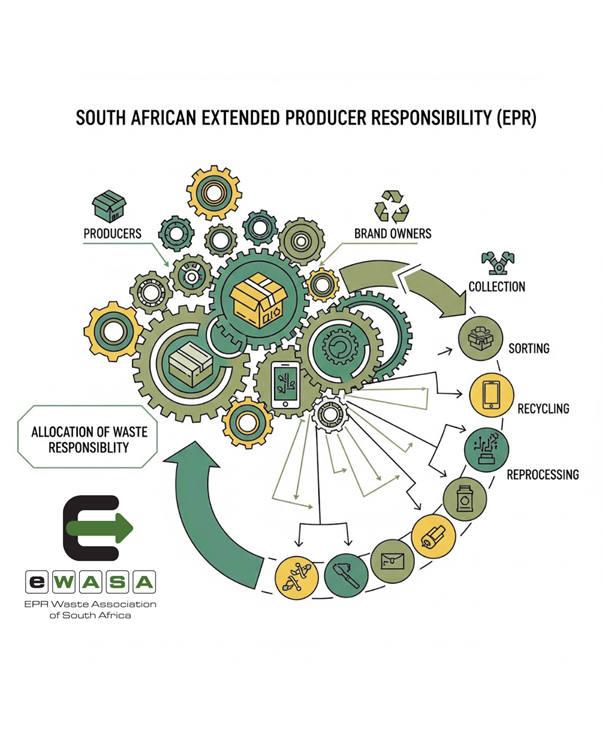
Who is a “Producer” Under South African EPR Law?
South Africa’s extended producer responsibility (EPR) regime is deceptively simple on paper: if you place certain “identified products” on the market, you must take responsibility for what happens to them after use. In practice, the hardest (and most contested) question is often the first one: who, exactly, is the “producer”?
That question drives everything that follows—registration, reporting, audits, and ultimately extended producer responsibility fees. It is also where today’s hottest debate sits: franchising models, multi-entity brand structures, and overlapping responsibilities that can lead to double-counting, disputed invoices, or accidental non-compliance.
This article unpacks the legal definition, then translates it into decision trees and real-world scenarios to help manufacturers, importers, brand owners, distributors, and retailers identify where obligations likely land under South Africa’s extended producer responsibility laws.
The legal backbone: section 18 + EPR Regulations + sector notices
EPR is enabled by section 18 of the National Environmental Management: Waste Act (NEMWA), which empowers the Minister to (1) identify products, (2) specify EPR measures, and (3) identify the person or category of persons responsible.
Those obligations are implemented through the Extended Producer Responsibility Regulations, 2020, and through sector-specific section 18 Notices that apply to specific product streams (such as Electrical and Electronic Equipment (EEE), lighting, lubricant oils, paper and packaging products and portable batteries).
The baseline definition: who counts as a “producer” in the Regulations?
The Regulations define a “producer” broadly as a person (including a brand owner) engaged in the commercial manufacture, conversion, refurbishment (where applicable) or import of identified products and importantly, they explicitly pull in the sector notice definitions where relevant.
That breadth is intentional: EPR is designed to prevent “free riders” and to capture the commercial actors who can influence product design, packaging choices, and the economics of end-of-life management.
But breadth creates friction in modern supply chains, especially where multiple entities can plausibly claim to be “the producer” for the same Stock Keeping Unit (SKU).
Why franchising is the flashpoint right now
Franchises introduce two structural complications:
- The brand and the seller are often different legal entities. A franchisor typically controls brand standards, packaging specifications, and sometimes procurement. The franchisee operates the point of sale and may import or purchase stock through channels the franchisor doesn’t directly control.
- Distribution and retail functions can be split across several entities. This matters because some sector notices include “distribution” in the producer definition (notably lighting).
The result: overlapping “producer-like” roles and confusion about who must register, report tonnages, and pay EPR fees, particularly where procurement is decentralised or where an international brand is involved.
Decision tree 1: start with the product stream (because definitions differ)
Different sector notices define “producer” differently, so don’t assume one rule fits all streams.

EEE and lighting both use broad categories, but lighting explicitly includes distribution, which can capture wholesalers and central procurement entities in franchise networks.
Decision tree 2: the packaging hierarchy (where most franchising disputes live)
Packaging is where South Africa’s framework gets most explicit and where franchising arguments usually concentrate because packaging touches brand ownership, private label, and retail execution.
The paper/packaging notice sets a hierarchy for producers who place more than a threshold tonnage on the market annually, then allocates “producer” status depending on where the brand owner sits and who brings goods into South Africa.

That “retailer fallback” is the clause that often alarms franchisees: if the supply chain can’t clearly identify a qualifying brand owner/agent/importer in South Africa, the retailer can be pulled into the frame.
Real-world franchising scenarios (and how the “producer” question plays out)
Scenario A: Franchisor controls packaging specs; franchisees operate stores
- Facts: The franchisor owns the brand and mandates packaging; franchisees buy packaged inputs from approved suppliers in South Africa.
- Likely producer (packaging): The brand owner (franchisor entity) is often the logical “producer lead” because it controls packaging design and places branded packaging into commerce via its network, while converters/manufacturers may also be captured by the wording.
- Practical compliance approach: Nominate a single reporting entity per stream (commonly the brand owner) and ensure franchisees are not double-reporting the same packaging tonnages.
Scenario B: Master franchise imports branded products (and packaging) into South Africa
- Facts: International brand owner is not domiciled in SA; the master franchisee imports.
- Likely producer (packaging): The licensed agent if formally appointed; otherwise the importer on the Bill of Lading.
- Typical pitfall: The brand owner’s global compliance team assumes SA obligations sit offshore; in SA, the obligation attaches to the local economic operator bringing goods to market.
Scenario C: Franchisee “grey imports” EEE (electronics) outside approved channels
- Facts: Franchisee imports devices directly.
- Likely producer (EEE): The importing franchisee becomes the producer because EEE producer status includes import.
- Takeaway: In franchise systems, EPR risk increases sharply when imports are decentralised.
Scenario D: Lighting wholesaler supplies franchise network; franchisor does central distribution
- Facts: A franchisor-owned distribution company buys and distributes lighting products to franchisees.
- Why this is contentious: Lighting’s producer definition includes distribution, so a distribution entity can be pulled into “producer” status even if it is not the brand owner.
- Practical fix: Treat the “first placer on market” (often importer/brand owner) as the reporting lead where possible, and document the allocation so the distributor and franchisees don’t duplicate obligations.
Scenario E: Lubricant oils sold through franchised service stations
- Facts: An oil company manufactures/imports lubricant oils; franchisees retail them.
- Likely producer: Usually the manufacturer/importer/brand owner under the Regulations’ core definition; the retailer is typically not the producer unless it imports or otherwise meets the producer tests.
Managing overlapping responsibilities: how to avoid double-paying (or non-paying)
Where multiple actors could qualify, compliance is less about debating theory and more about proving a single, defensible allocation:
- Map “placing on the market” by legal entity (not by brand family). Include import documentation, invoices, and internal transfer pricing.
- Assign a “producer lead” per waste stream in contracts (especially franchise and distribution agreements).
- Align data flows: the reporting entity must have credible tonnage/units data across the network.
- Check the sector notice rules first (packaging is hierarchical; lighting explicitly includes distribution).
How do I register my business for extended producer responsibility schemes?
Registration is done through the Department’s online EPR system on SAWIC. After successful registration, producers/PROs receive a unique registration number used for ongoing submissions and reporting.
A practical step sequence looks like this:
- Confirm you place “identified products” on the SA market (by stream and legal entity).
- Register on the SAWIC EPR portal as a producer (and/or via a PRO route where applicable).
- Join a Producer Responsibility Organisation (PRO) or implement your own scheme, then comply with reporting, audits, and fee rules.
- Pay EPR fees and submit required reports in line with the Regulations (fee-setting is guided by criteria in the Regulations and DFFE guidance).
This is the operational heart of South Africa’s extended producer responsibility system: registration + scheme membership (or own scheme) + fees + reporting.
What companies in South Africa offer extended producer responsibility compliance service
Companies typically access compliance support through
(1) Producer Responsibility Organisations, and
(2) specialist advisors (legal/environmental compliance consultancies).
Examples of PROs and PRO-type compliance routes include:
- eWASA, a registered PRO covering multiple streams including EEE, lighting, portable batteries, lubricant oils, and paper/packaging.
- PETCO (packaging-focused PRO).
- Fibre Circle (paper and paper packaging PRO).
- Circular Energy (EPR compliance pathway across several streams, per its public guidance).
- ERA (EEE-related membership instructions reference SAWIC registration as part of compliance steps).
- PASA (Producer Responsibility Association of South Africa), a collaborative platform for Producer Responsibility Organisations (PROs) within the Extended Producer Responsibility (EPR) framework
Bottom line for franchises and multi-entity groups
If your business model separates brand ownership, importing, distribution, and retail, you should assume EPR will require an explicit allocation per stream, per legal entity, backed by data.
Start with the sector notice, apply the decision trees, and then make the allocation operational through registration, reporting control, and contractual clarity. That is the fastest path to defensible compliance, and the surest way to avoid the twin risks dominating EPR conversations right now: double-paying and accidental non-compliance.