The Monthly EPR Metrics Producers Need to Record
Extended Producer Responsibility is no longer something South African producers can treat as a once-off registration exercise. The regulatory base has been in place since November 2020, and the administrative system around it now runs on ongoing declarations, reconciliations, invoicing, and prescribed reporting through the Department of Forestry, Fisheries and the Environment (DFFE) EPR system and related waste information platforms.
In practice, that means compliance risk no longer sits only with legal teams. It now sits with finance, supply chain, operations, sustainability, and whoever owns product master data. If those teams cannot produce accurate numbers every month, year-end reporting becomes a scramble, fees become harder to defend, and target performance becomes harder to prove.
EPR rules that drive monthly reporting
South Africa’s EPR framework sits under Section 18 of the National Environmental Management: Waste Act and started with the 2020 regulations and notices for electrical and electronic equipment, lighting, and paper and packaging. eWASA’s compliance guidance notes that the system now applies across six industries: paper and packaging, electronics, batteries, pesticides, lubricant oils, and lighting.
Producers must register with the Department and either join or operate an EPR scheme. They must pay the relevant fees and meet monitoring and reporting obligations. Statutory reporting is not limited to a single annual event, either. The eWASA guidance for producers and PROs points to interim and annual performance reporting, while the wider SAWIS environment is built around routine waste data capture. That is why monthly reporting discipline matters so much, even where the legal filing date comes later.
Metric #1: Products placed on the market (POM)
The first number every producer should track monthly is products placed on the market, by units and by weight, broken down into the product categories and material groups your PRO or internal scheme actually uses. This is the number that drives fee calculations, and it also becomes the baseline against which collection and recycling performance is judged later. If your POM data is weak, every downstream metric becomes unstable.
The practical fix is not glamorous: align SKUs, bills of material, pack formats, and HS code logic to the reporting template you use externally. eWASA hosts central online put-on-the-market declarations and simplified reporting across multiple categories.
Metric #2: Waste collected, reused, recycled and recovered
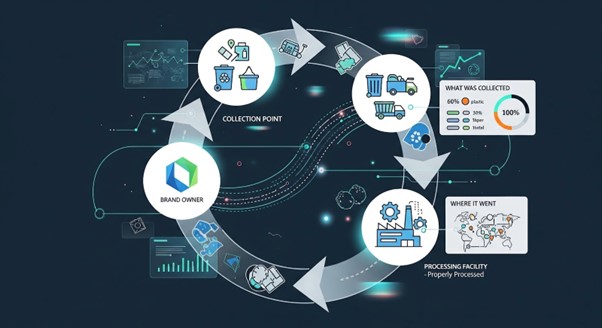
The second monthly metric group is what happens after products become waste: what was collected, what was prepared for reuse, what was recycled, what went to other recovery routes, and what still ended up in disposal. At policy level, DFFE’s EPR framework links producer obligations directly to collection, storage, transport, recycling, recovery, and treatment, and notes that targets are reviewed over time. For producers, the immediate risk is double counting. If municipalities, service providers, and more than one PRO handle the same tonnage, your monthly records must clearly show a chain of custody to prevent the same material from being claimed twice.
Metric #3: EPR fees, costs and nett cost recovery
A compliant EPR dashboard cannot stop at tonnes. It also has to show whether your fee model is tracking against nett cost recovery. The amended fee language cited in DFFE material is clear that EPR fees must be based on nett cost recovery and use differentiated rates per item category. DFFE’s fee toolkit process, published in 2024, reinforces that fee setting is not supposed to be arbitrary or opaque. Producers should therefore track, every month, not only fees invoiced and paid, but also the eligible costs those fees are meant to cover:
- collection,
- transport,
- storage where relevant,
- treatment,
- administration,
- awareness,
- verification,
- and other scheme costs.
Waiting until quarter-end or year-end to test under-recovery or over-recovery is risky.
Metric #4: Design, recyclability and eco modulation inputs
This is the metric group many producers still treat as optional, but it is moving closer to the centre of EPR economics. South Africa’s fee direction has been pointing toward differentiated pricing based on item category, weight, and recyclability, while proposed amendment language also links the EPR system to environmental labels and declarations under SANS/ISO 14021 and 14024.
Even where a sector has not fully rolled out eco-modulated fees, producers should already be capturing the design variables that will matter later:
- recycled content,
- repairability,
- hazardous components,
- composite materials,
- ease of dismantling,
- and the presence of disruptive parts that make recycling harder.
A producer that starts building this dataset now will be in a much better position to defend fee classifications, redesign products intelligently, and prepare future label or LCA work without rebuilding its master data from scratch.
Metric #5: Informal sector, SMMEs and transformation
EPR in South Africa is not only about environmental tonnages. DFFE’s implementation material ties the framework directly to circular economy outcomes, transformation, and the integration of the informal sector into the post-consumer collection value chain. Proposed amendment language goes further by referring to compensation for registered informal collectors and to BBBEE-related transformation measures with attention to women, youth, and persons with disabilities. That means producers should not wait for an annual social report to gather these numbers. Track them monthly:
- how many informal collectors are integrated into your chain,
- what volumes they deliver,
- how quickly they are paid,
- whether payment levels are tracking against a fair service benchmark,
- how much spend reaches SMMEs,
- and which contracts include transformation indicators.
If these numbers are absent from monthly supplier reporting, they usually remain absent from year-end compliance narratives as well.
Metric #6: Data quality, free riders and compliance risk
The sixth metric group is about the health of your reporting system itself. DFFE’s amendment text defines a “free rider” as a firm or individual benefiting from an EPR scheme without fully complying, and SAWIS verification material makes clear that reporting entities must be able to produce records, supporting documents, and the method used to quantify waste data. That makes completeness, timeliness, reconciliation, and exception management monthly control issues, not admin housekeeping.
- Producers should be able to answer basic questions at any time:
- which members or business units have reported,
- which figures were corrected,
- which tonnages do not reconcile against invoices or manifests,
- and where unregistered competitors may be distorting the economics of the scheme.
A simple dashboard with red-flag rules often does more for compliance than a sophisticated annual narrative written too late.
Looking ahead: using monthly data for LCA, labels and strategy
The strongest reason to take monthly EPR data seriously is that it creates value beyond compliance. eWASA’s member offering already includes life-cycle assessment support, and the policy direction from DFFE continues to connect EPR to circular economy planning, fee methodology, labelling, and broader system performance. At the same time, the Department has continued consulting on further amendments, with the late-2024 commenting period extended and stakeholder inputs still under consideration in subsequent implementation updates.
Producers should read that signal correctly: the regulatory direction is toward tighter evidence, better traceability, and clearer justification for both fees and claims. A clean monthly dataset makes it easier to run LCAs, support environmental declarations, review product design choices, plan budget cycles, and report publicly with more credibility.
Conclusion
If you are a producer, importer, retailer, recycler, refurbisher, or collector operating in an EPR-liable stream, now is the right time to audit your reporting template against these six metric groups. Ask a hard question: can your business produce accurate monthly numbers for POM, downstream tonnages, fee recovery, design attributes, transformation indicators, and data quality controls without a manual scramble? If the answer is no, the fix is not to wait for the next audit deadline. It is to tighten the monthly rhythm now. For businesses operating across several product classes, there is a strong case for working with a multi-stream producer responsibility organisation that can simplify declarations, reporting, and performance management across sectors.
eWASA positions that offer as a one-stop-shop model covering five EPR sectors, with central online POM declarations, performance reporting support, and a single point of contact for producers handling multi-stream obligations.
References
- Department of Forestry, Fisheries and the Environment. (2020). National Environmental Management: Waste Act, 2008 (Act No. 59 of 2008): Regulations regarding extended producer responsibility (Government Gazette No. 43879, Government Notice No. R.1184).
- Department of Forestry, Fisheries and the Environment. (2021). National Environmental Management: Waste Act, 2008 (Act No. 59 of 2008): Draft amendments to the regulations and notices regarding extended producer responsibility, 2020 (Government Gazette No. 44295, Government Notice No. 239).
- Department of Forestry, Fisheries and the Environment. (2024a). National Environmental Management: Waste Act (59/2008): Draft guideline and toolkit for the determination of extended producer responsibility fees [G 50067 – GoN 4308].
- Department of Forestry, Fisheries and the Environment. (2024b). National Environmental Management: Waste Act (Act No. 59 of 2008): Notice of extension of commenting period on the proposed amendments to the regulations and notices regarding extended producer responsibility, 2020 [G 51825 – GoN 5735].
- Department of Forestry, Fisheries and the Environment. (n.d.). Registration in terms of the Regulations regarding extended producer responsibility, 2020.