What Does an EPR Fee Actually Pay For?
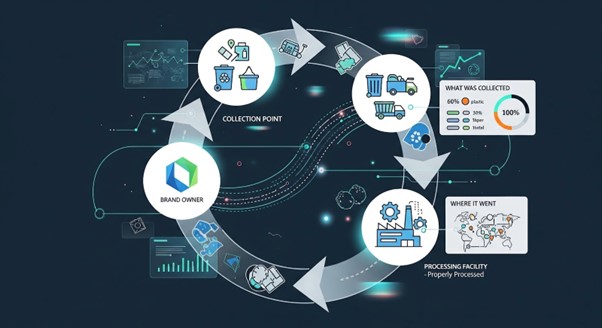
An EPR fee is more than a compliance charge. It helps finance the collection, logistics, processing, data and public participation needed to manage identified products after use.
An EPR fee helps fund the practical systems needed after an identified product has been placed on the South African market, used and discarded. Depending on the product stream, that journey can include collection, storage, transport, sorting, dismantling, reuse, repair, recycling, treatment, reporting and independent verification.
The fee connects a producer’s market activity with the real cost of managing that product at the post-consumer stage.
Why producers pay EPR fees
South Africa’s Extended Producer Responsibility Regulations define EPR as an approach in which a producer’s responsibility extends to the post-consumer stage of a product’s life cycle. The Regulations apply to products identified through notices issued under section 18 of the National Environmental Management: Waste Act, 2008.
In plain language, the responsibility does not end when the product is sold. Producers must contribute to a workable system for managing identified products after use. They may implement an individual EPR scheme or work through a registered Producer Responsibility Organisation (PRO), subject to the applicable requirements. A producer that appoints a PRO still has responsibilities, including accurate product classification, declarations and reporting.
This approach reflects the polluter-pays principle. It shifts more operational and financial responsibility for post-consumer products to the businesses that place them on the market, rather than leaving municipalities and the public to carry the full cost of increasingly complex waste streams.
According to the Department of Forestry, Fisheries and the Environment 2024 fee guideline, EPR fees should support nett cost recovery. In other words, fees should cover the relevant costs of the scheme, less revenue earned from selling recovered material. This matters because the value of recovered material does not always cover collection and treatment. Some items have positive material value, while others require specialist handling even when they generate little or no return.
From sale to recovery: what the fee can support
An EPR fee does not fund one activity in isolation. It supports a connected system. If one link fails, the product may be collected without reaching a credible reuse, recycling, recovery or treatment outcome.
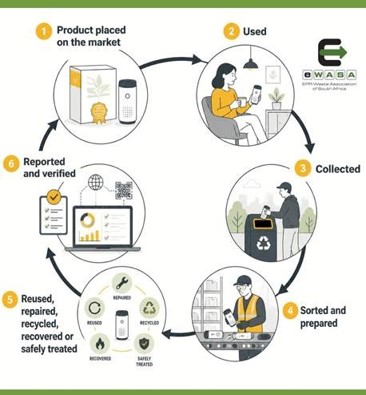
The exact allocation differs by product stream and scheme, but the journey below explains the main activities an EPR fee can support.
1. Making it possible for people to return products after use
People need convenient and trusted return routes. These may include collection points at retailers, municipal sites, buy-back centres, schools and offices, as well as community collection events, business-to-business services and reverse-logistics programmes.
The system may require bins, cages, skips, signage and temporary storage equipment. Collection-point hosts may also need training so that they can accept the correct products, prevent contamination and explain safe handling to the public.
South Africa’s collection coverage differs across municipalities, towns and waste streams. Specialist products such as e-waste, lighting equipment, batteries and used oil cannot simply be managed in the same way as dry mixed packaging.
Why not use the household bin? Many identified products need separate handling. Batteries can create fire risks, fluorescent lamps may contain mercury, and e-waste contains a complex mix of components. Separate collection helps direct these products towards appropriate downstream processes.
2. Moving and storing material safely
A product is not recycled when somebody drops it off. It still needs to move from the collection point to a consolidation facility, sorter, dismantler, refurbisher, recycler or treatment facility.
Transport can be a substantial cost in a geographically dispersed country, particularly when small quantities must be collected from many locations. Materials may also need secure interim storage and controls to prevent breakage, leakage, theft, illegal dumping or contamination.
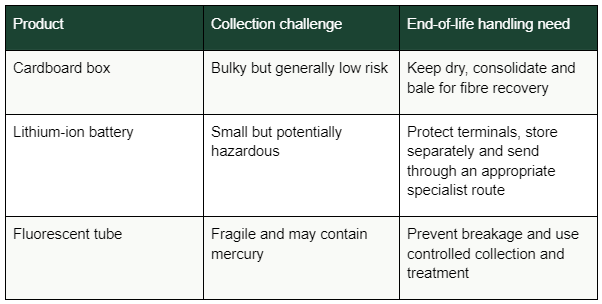
These differences help explain why one fee cannot sensibly apply to every product in the same way.
3. Turning collected products into usable streams
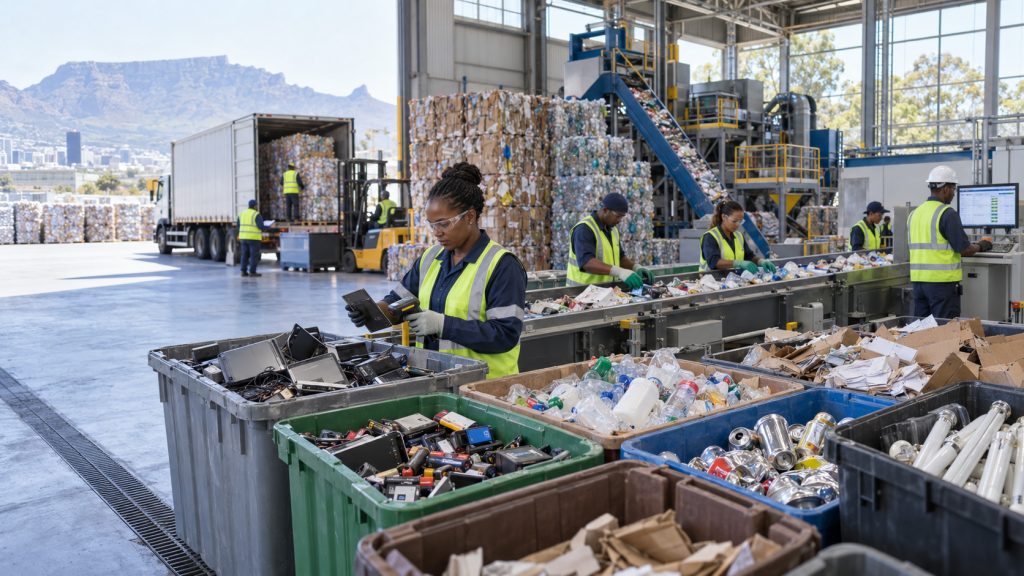
Collection produces a mixed input, not necessarily a recycling-ready material. Packaging may need to be separated by material type, grade and colour. Contamination must be removed. Caps/Closures, labels, sleeves, pumps, adhesives and multilayer components can affect sorting and processing.
Electrical and electronic equipment may need testing for reuse or refurbishment before it is dismantled. Dismantlers separate components and hazardous fractions, while processors may bale, shred, granulate or otherwise prepare materials to meet a recycler’s specification.
Contamination adds cost and can reduce both material quality and market value. It can also make an otherwise recyclable item unsuitable for the available local process.
Collection is a starting point, not an outcome. A credible system must be able to show what happened next.
4. Processing material and managing hazardous fractions
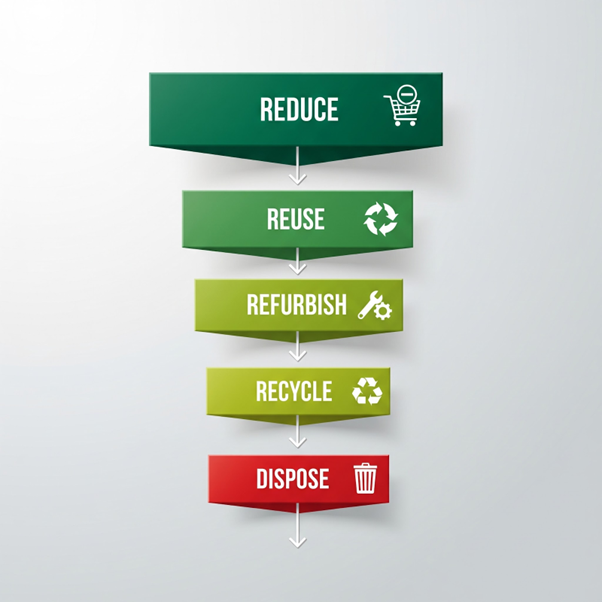
The next stage may involve reuse, repair, refurbishment, remanufacturing, recycling, another approved recovery route or safe treatment. Reuse and repair can retain more of a product’s value than breaking it down for material recycling, where appropriate and safe.
Not every collected item becomes the same product again. Metals, plastics, glass and fibre may become secondary raw materials for different applications. Some parts may be reusable, while residual or hazardous fractions require controlled treatment or disposal.
Material value also varies. Revenue from a valuable recovered material can offset part of the system cost. By contrast, a difficult or hazardous fraction may be expensive to manage and offer no financial return. Responsible end-of-life management must account for both.
5. Supporting markets for recovered materials
Recycling depends on demand. A processor needs a buyer that can use the recovered material at the required quality and volume. Without a viable end market, collected material can become a storage problem rather than a circular input.
EPR funding can help support research, trials, infrastructure and partnerships that develop local processing capacity and markets for secondary materials. Producers can strengthen this part of the system through product design, recycled-content procurement and credible long-term offtake arrangements.
An end market is not an abstract environmental benefit. It is the manufacturer or other user that purchases recovered material and puts it back into productive use.
6. Measuring and verifying what happened
Data and audits are part of the recycling system, not paperwork added after the event. Producers and schemes need reliable information about the identified products placed on the market and the waste collected, sorted, recycled, recovered, refurbished, exported or disposed of, as applicable.
Evidence may include weight records, collection records, invoices, recycler certificates and downstream documentation. The EPR Regulations also provide for reporting, financial and performance audits, and departmental verification.
This evidence supports performance monitoring, reduces the risk of double counting and helps distinguish a completed downstream outcome from an unsupported claim. It also protects compliant producers from being undermined by free riders that benefit from the system without contributing to its costs.
7. Helping people use the system correctly
Collection infrastructure works only when people know it exists, understand what it accepts and trust where their products will go. Public awareness, clear signage, staff training and school, retailer or community campaigns can improve participation and reduce contamination.
This is why the EPR fee criteria include public communication and awareness raising. Education is not separate from implementation. It helps improve the quantity and quality of material entering the system and supports safer behaviour around specialist streams.
Why one product’s EPR fee differs from another’s
The Regulations and 2024 fee guideline do not treat all identified products as if they create the same end-of-life cost. Fee determination can consider several operational and market factors.
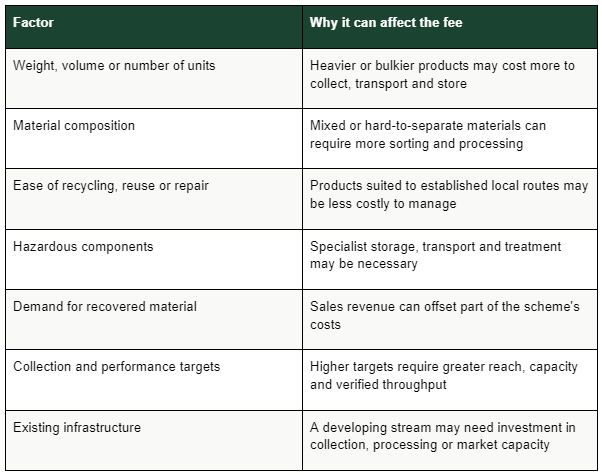
The guideline describes flat, modulated, eco-modulated and product take-back approaches. The appropriate method depends on factors such as product characteristics and sector maturity. No single formula suits every waste stream.
Fees may also change as operating costs, targets, infrastructure needs and market conditions evolve. A low fee is therefore not automatically evidence of an efficient system, just as a high fee is not automatically evidence of better performance. Producers need to examine what the fee covers and what the scheme can demonstrate.
What producers should expect from an EPR scheme
Producers should not have to take the value of their contribution on faith. They should receive clear information about their obligations, the fee structure, the services funded and the evidence used to measure performance.
A credible EPR scheme should be able to explain:
- which products and materials it covers;
- what data producers must submit and how that data is checked;
- how fees are calculated, categorised and reviewed;
- which collection, logistics, recycling, recovery or treatment activities the fees support;
- how service providers and downstream processors are selected and monitored;
- how material is traced from collection to a documented outcome;
- how performance against applicable targets is measured and reported;
- what financial and performance information is audited or independently verified;
- how members are informed about fee changes, reporting deadlines and programme developments; and
- how producers can ask questions, raise concerns and obtain supporting records.
Transparency also depends on the producer. Accurate product classification and market declarations are essential because schemes plan infrastructure, services and budgets around the products and quantities members report. Poor data weakens fee setting and makes system performance harder to measure.
The fee can become a product-design signal
EPR has strategic value beyond the compliance function. Product and packaging decisions affect collection, sorting, repair and recycling long before an item reaches a bin or drop-off point.
A format that costs less to buy may create a higher end-of-life cost if it is difficult to separate, easily contaminated or unsupported by realistic local recycling capacity. A more complete decision considers material use, product protection, durability, repairability, collection compatibility, recovered-material quality, end-market demand and likely EPR implications.
Where differentiated or eco-modulated fees apply, the fee can reinforce these design choices. Product, procurement, packaging, finance and compliance teams should therefore discuss EPR before a product reaches the market, rather than treating the fee as an after-the-fact administrative charge.
The fee is the beginning of responsibility, not the end
An EPR fee does not make waste disappear, and it cannot guarantee that every individual item will be recycled. It provides funding for the connected systems needed to manage identified products after use, including return pathways, logistics, preparation, processing, market development, awareness, measurement and proof.
For producers, the most useful question is not only, “How much is the fee?” It is also, “What system is this funding, what outcomes can it demonstrate, and how can our product decisions make that system work better?”
eWASA manages EPR schemes across electrical and electronic equipment, lighting equipment, paper and packaging products, portable batteries and lubricant oils. Speak to us about your product categories, market declarations, reporting requirements and EPR membership options.
References
- Department of Environment, Forestry and Fisheries. (2020). Regulations regarding extended producer responsibility (Government Notice 1184, Government Gazette 43879), as amended. https://www.gov.za/sites/default/files/gcis_document/202011/43879gon1184.pdf
- Department of Forestry, Fisheries and the Environment. (2024). Guideline and toolkit for the determination of extended producer responsibility fees (Government Notice 5535, Government Gazette 51534). https://www.gov.za/sites/default/files/gcis_document/202411/51534gon5535.pdf
- Department of Forestry, Fisheries and the Environment. (2024). Amendments to the Regulations regarding extended producer responsibility (Government Notice 5520, Government Gazette 51513). https://www.gov.za/sites/default/files/gcis_document/202411/51513gon5520.pdf