
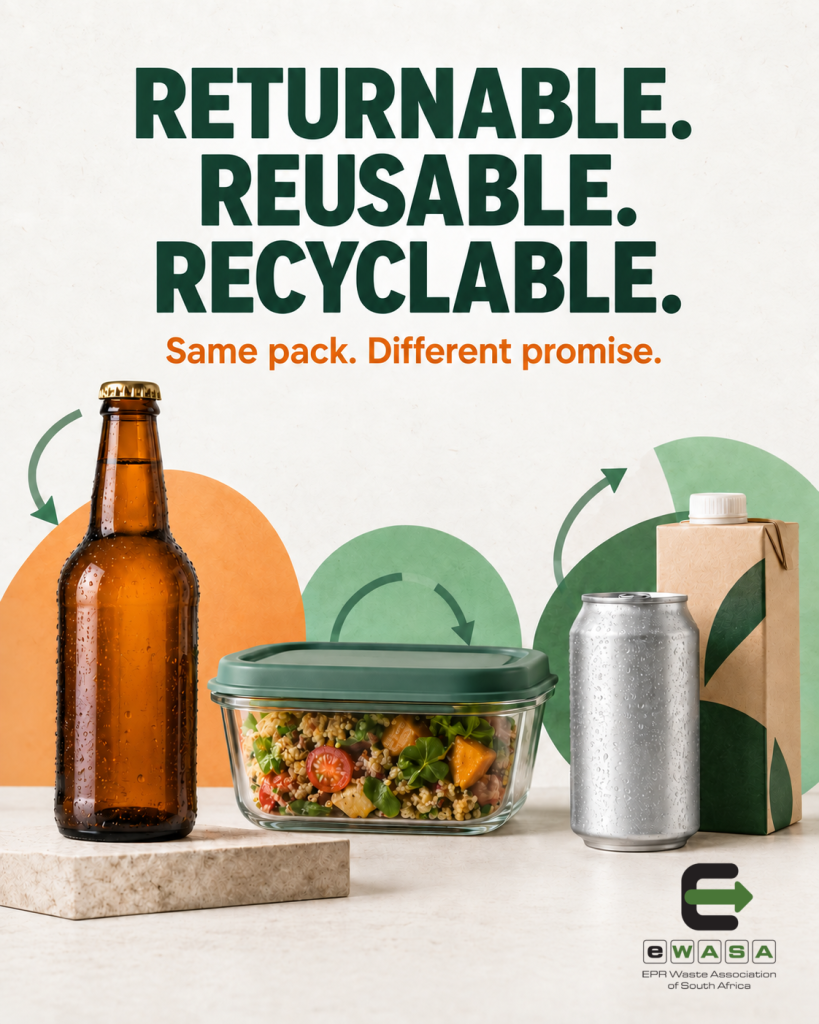
Returnable, Reusable and Recyclable?
A packaging label may use familiar words such as returnable, reusable or recyclable. Each word makes a different promise about what should happen next, and each promise depends on more than the material itself.
A glass bottle, for example, may be recyclable, returnable or both. If it is recyclable, you need a viable way to collect, sort and process it into secondary material. If it is returnable, you need a practical route to send it back. If it is reusable, its design and intended use should support reuse.
Clear descriptions help people make better decisions after use. It is how businesses can communicate responsibly. In South Africa, the Consumer Protection Act prohibits deceptive, false, or misleading marketing claims. Labels therefore need precise wording, supporting evidence and instructions that match the market in which the packaging is sold.
What returnable packaging requires
Returnable packaging is intentionally designed to move back through a controlled system rather than be discarded after one use. The return route may involve a retailer take-back point, a deposit-return arrangement, a collection point, collection by a delivery driver, or a business-to-business recovery service.
The claim becomes meaningful when the whole return system works. Someone must collect and transport the packaging, identify and sort it, inspect its condition and direct it to cleaning, repair, refilling, reuse or appropriate recovery. The packaging must also withstand the intended number of trips without compromising product safety or function.
Consumers need to know where to return the item, whether a deposit or incentive applies, which components belong in the system and what condition the packaging should be in. Businesses should also monitor return rates and actual outcomes wherever possible.
Common examples include refillable beverage bottles collected through a retailer network, reusable crates and pallets recovered from commercial customers, and household-product containers returned or exchanged at a refill station. A package is not meaningfully returnable simply because a consumer could theoretically take it somewhere. The return route must be practical, accessible and actively operated.
What reusable packaging requires
Reusable packaging is designed and intended for repeated use for the same or a similar purpose. Reuse may happen in the home, at a business, or within a managed service. Examples include refillable water bottles, durable takeaway containers used in a return-and-wash scheme, reusable shopping bags and cleaning-product bottles paired with refills or concentrates.
Durability matters, but it is only one part of the model. Businesses should consider how the packaging will be cleaned, handled, stored and refilled. Food, beverage, cosmetic and household-chemical packaging may need specific hygiene and safety instructions. Closures, labels and replaceable parts should also support the intended life of the container.
The environmental case for reuse depends on real behaviour and system performance. Manufacturing a more durable item may require more material or energy upfront, while washing and return transport create additional impacts. The number of uses achieved, transport distances, cleaning method and rate of loss or damage all influence the result. This is why no packaging format is automatically the best option in every context.
A container does not become reusable merely because it can be used again. The claim should reflect what the packaging was designed, tested, communicated and reasonably expected to do. Businesses should define the intended reuse and give consumers the information needed to follow it safely.
What recyclable packaging requires
Recyclable packaging needs more than a technically recoverable material. It should have a realistic collection, sorting and processing route in the market where it is sold. A material may perform well in laboratory conditions but still fail to reach a recycler if no suitable collection stream or end market exists.
Start with the complete pack, not only the main container. Multi-layer structures, mixed materials, dark pigments, sleeves, labels, adhesives, closures, liners, contamination and very small formats can affect whether sorting equipment or manual sorters can identify and separate the item. Design choices should align with the specifications and capabilities of the local recycling value chain.
Collection access also varies across South Africa. Municipal services, private collectors, buy-back centres, drop-off points and informal collection activity differ by area and material type. A claim should not suggest that every household has the same access to recycling. Where kerbside collection is not available, instructions should identify a realistic alternative route.
A viable end market matters too. Recyclers need buyers for the recovered material. Without demand for secondary resources, collection and processing may not remain economically viable. Producers and their producer responsibility organisations therefore have a role in supporting collection, recycling capacity, data and markets for recycled material.
These terms should not be confused:
- Recyclable describes whether the packaging can be recycled in the market.
- Made with recycled content describes the recovered material used to manufacture the packaging. State the percentage and the component covered where relevant.
- Say whether you mean that material was recycled before manufacture or that used packaging was collected and processed after use.
Clear disposal instructions can improve the chance of recovery. Tell consumers whether to empty or rinse the pack, keep components together or separate them, and use a household collection, buy-back centre or designated drop-off point. Keep the instruction short enough to follow and specific enough to be useful.
Design alone is not enough
South Africa’s EPR framework reinforces a life-cycle approach. Producers must look beyond the point of sale and consider how products and packaging can support reuse, recycling or recovery without compromising their function. The national Recyclability by Design guideline for packaging and paper also provides a useful reference for packaging decisions in the South African context.
Sustainable packaging works as a system, not as a label. A recyclable tray placed in general waste may end up in landfill. A reusable cup used once has not delivered its intended benefit. A returnable bottle without accessible return points is unlikely to complete the loop.
Good outcomes require alignment between packaging design, supply-chain partners, collection systems, consumer convenience, instructions, sorting and processing capacity, end-market demand and EPR reporting. Marketing teams should work with packaging, sustainability, procurement, legal and compliance colleagues before a claim goes live.
A practical check before making the claim
- Define exactly what you mean by returnable, reusable or recyclable.
- Confirm that the claim reflects the full packaging format and the actual market in which it is sold.
- Identify the components covered, such as the bottle, cap, label, sleeve, liner or carton.
- Test whether consumers can understand the instruction and realistically act on it.
- Avoid broad, unqualified language such as eco-friendly, planet-safe, zero waste or fully sustainable.
- Do not imply that all consumers have equal access to return or recycling infrastructure.
- Keep evidence, including specifications, test results, cleaning or reuse protocols, collection information, recycler confirmation and programme data.
- Review the claim with packaging, EPR, sustainability, legal, compliance and marketing teams.
- Measure real-world outcomes and update the claim if the packaging or supporting system changes.
Choose the claim that matches the journey
Returnable, reusable and recyclable are not interchangeable badges. Each describes a different intended journey after use. A credible claim connects the wording on the pack to a design that supports it, a system that can deliver it and instructions that people can follow.
When businesses make that connection, they give consumers a clearer next step and strengthen responsible end-of-life management. They also create better information for EPR planning, recovery partnerships and future packaging decisions.
eWASA supports producers in understanding their EPR responsibilities and strengthening practical collection, recovery and recycling systems. Contact us for guidance on producer responsibility, packaging end-of-life management and clear sustainability communication.

