
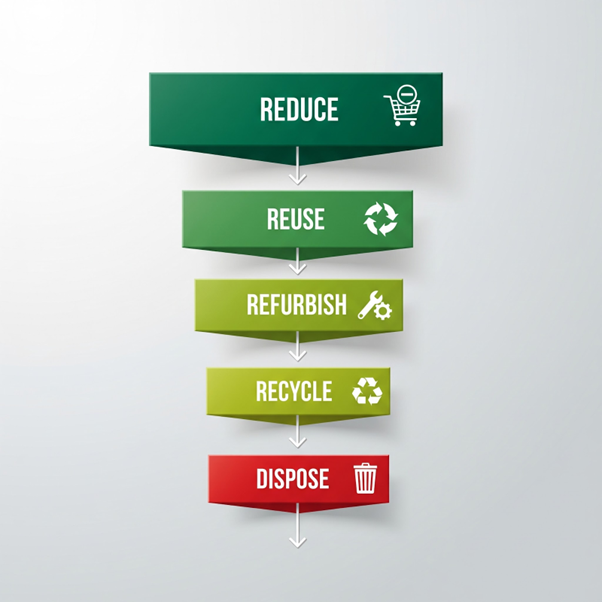
How Refurbishers Support EPR and Circularity for Electronics
Too many electronic devices are written off as waste before their useful life is truly over. A laptop with a failed battery, a monitor with a minor fault, or a phone returned through a take-back programme may still hold significant value. Refurbishment changes the question from “How do we dispose of this?” to “Can we keep this product in use safely and responsibly?”
That matters in South Africa’s Extended Producer Responsibility framework, under which producers remain responsible at the post-consumer stage and must facilitate environmentally friendly disposal, such as recycling or refurbishing.
For producers, retailers, refurbishers, collectors, and the wider waste system, refurbishment sits at the point where compliance can begin to create circular value. It extends product life, reduces pressure on landfills, and improves the quality of downstream EPR outcomes.
Refurbishment in an EPR System
Refurbishment means restoring a used device to a reliable working condition so it can be used again. In plain terms, it goes beyond a one-off repair but stops short of treating the product as waste for material recovery. That distinction matters. EPR is not limited to disposal at the end of life. It is about waste minimisation, recovery, repair, reuse, and full-circle waste management.
A well-run electronics refurbishment process restores function through testing, repair, cleaning, grading and controlled quality checks. The circular benefit is straightforward: keeping a device in service for longer delays disposal and reduces demand for replacement manufacturing.
Modern EPR systems increasingly need to show more than tonnage sent for treatment. They need defensible evidence of what happened to returned products. In South Africa, public EPR guidance already recognises recycling and refurbishing as post-consumer pathways, and the 2024 proposed amendments to the EPR regulations explicitly call for allocating scheme funding across collection, recycling, reuse, and other components.
Circularity is Stronger When Reuse Comes Before Recycling
Recycling remains necessary for equipment that is unsafe, obsolete, or beyond economic repair. But refurbishment captures more value earlier in the chain because it preserves product utility, not only raw materials. Reuse first, recycle second. In circular economy electronics, that sequence matters because it keeps working products and components at a higher value for longer.
How Refurbishers Support Producers’ EPR Goals
For producers and retailers, the practical value of refurbishment starts once products come back through an electronics take-back scheme, warranty return, trade-in channel or IT asset disposal programme. Refurbishers are the actors who decide what can go back into use, what can be harvested for parts, and what should move to final recycling. That makes them important operational partners in any serious EPR system.
They Improve Collection and Take-back Outcomes
Returned devices do not all belong in the same stream. Some can be reused almost immediately. Others need refurbishment. Others only have parts value. Others are true end-of-life waste. Refurbishers make that triage possible. Close the Loop describes this as a secure take-back and assessment process that routes functioning units to reuse and non-functioning units to responsible recycling. For producers and retailers, that strengthens reverse logistics and improves control over what happens after collection.
They Turn “Waste” into Measurable Diversion
When reusable equipment is identified early, producers avoid pushing viable devices straight into shredding or landfill. That creates measurable diversion from premature disposal and a more credible EPR performance story. eWASA’s own guidance frames repair, donation, resale and trade-in as the preferred route for working electronics, while broken end-of-life devices should move into compliant recovery channels.
They Create Value for Multiple Stakeholders
The gains are shared across the system. Producers and retailers get a stronger compliance narrative and more options for circular procurement and take-back. Consumers gain lower-cost access to functional devices. Communities and SMEs benefit where refurbishment supports enterprise development and local jobs. Recyclers benefit too because clearer sorting separates reusable units from material recovery streams. Formalised e-waste programmes are linked to job creation, SME development and broader community benefit. Refurbishers in the eWASA network show how reuse can improve access to equipment for work and school.
They Support Transparency and Defensible Outcomes
Good refurbishment is not informal resale with better marketing. It depends on traceability, testing, grading, data handling and documentation. ERS explicitly positions EPR support around take-back systems, compliance, and reporting analytics, while refurbishment operators describe tested reuse pathways and strict data security. That kind of documentation matters because EPR systems need a clear distinction between reuse, refurbishment and recycling.
Recognise Good Refurbishment
The quality question matters. Refurbishment only supports circularity when buyers, producers and regulators can trust the outcome. That means disciplined processes, clear decision points and fit-for-purpose controls.
Triage, Testing and Grading
Collected units should first be logged, assessed and sorted by condition, age, fault profile and reuse potential. A professional process screens for fit-for-purpose use rather than assuming every return deserves the same treatment. Refurbishers describe multi-point inspection, testing and device routing based on condition. That is the difference between controlled refurbishment and a vague second-hand stream.
Repair, Data Wiping and Quality Control
Once a unit passes triage, refurbishment may involve minor repairs, parts replacement, deep cleaning, software updates and secure data removal. Data wiping is not a side issue. It is central to trust. Users should back up data, sign out of accounts, remove SD cards, and use factory reset or secure wipe tools before donation or recycling. Refurbishment partners also emphasise certified wiping or sanitisation as part of the process.
Warranty and Resale Confidence
Professional refurbishment usually includes some form of warranty because the market needs proof that the device has been properly checked. South African refurbishers show warranties ranging from three months to twelve months, depending on the business and product type. That is a practical marker separating professional refurbishment from informal resale.
Clear End-of-line Decisions
Not every device should be saved. If a product cannot be restored safely, economically or reliably, it should exit the refurbishment stream and move to responsible recycling and material recovery. Good systems make that decision early and document it clearly. That protects buyers, supports accurate reporting, and keeps the repair-refurbish-recycle sequence intact. 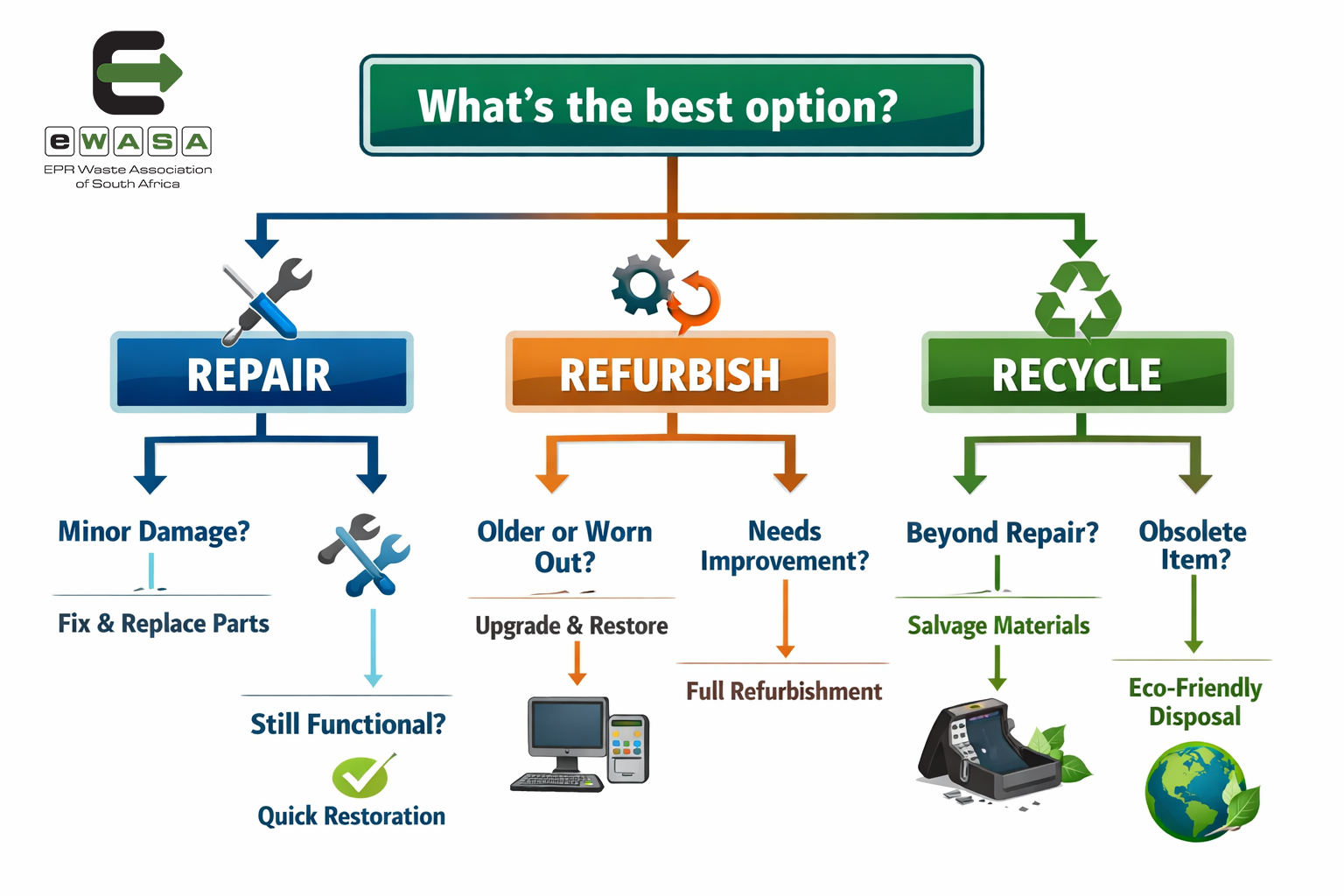
South African EPR Creates the Right Framework
South African EPR applies to electronic and electrical equipment, and producers must facilitate environmentally friendly post-consumer pathways such as recycling or refurbishing. Review EPR legislation and regulations in the eWASA resource hub.
The local ecosystem is already active. eWASA’s refurbisher network includes businesses that collect used equipment, refurbish what they can, donate some units to schools or charities, resell others, and recycle the balance responsibly. That gives the South African market a credible set of partner stories showing how waste electronics can become new opportunities.
FAQs
What is the difference between repair, refurbishment and recycling?
Repair fixes a specific fault. Refurbishment restores a device to reliable working condition for reuse. Recycling breaks end-of-life equipment down to recover materials.
Does refurbishment support EPR compliance?
Yes. It supports EPR by moving suitable products into a recognised post-consumer pathway instead of defaulting every return to disposal or material recovery.
Do refurbished electronics count as waste diversion?
In practice, yes. Refurbishment diverts viable products away from landfill and premature destruction, while documenting a reuse outcome.
When should a device be recycled instead of refurbished?
When it cannot be restored safely, reliably or economically, it should move to responsible recycling.
What standards matter in electronics refurbishment?
At minimum, traceability, testing, grading, secure data handling and clear documentation of outcomes matter.
Why does data wiping matter?
It protects users and businesses from data leakage and is a core trust requirement in any refurbishment or redeployment process.
Do refurbished electronics come with warranties?
Often, yes. eWASA’s current local examples show warranties from three to twelve months.
Conclusion
Refurbishment extends product life, reduces unnecessary waste and keeps more value in the electronics system for longer. In an EPR framework, that matters because producers are not only managing end-of-life obligations. They are shaping what happens to products after use, and refurbishers help turn that responsibility into a more circular outcome.
South Africa already has the policy signals, the public guidance and the growing ecosystem to support this model. For businesses looking to strengthen compliance and circularity, the next step is practical: review the guidance, check the regulations that apply to your sector, and speak to eWASA about a compliant waste management strategy built around collection, refurbishment and responsible recycling.
References
- Close the Loop. IT refurbishment & circular IT solutions.
- ERS International. (n.d.). Producer responsibility & EPR compliance. Stickland, J. (2024, February 16). Circular opportunities for e-waste repair and reuse of electrical and electronic equipment in South Africa. WasteAid.

