
Five-stream Clean-up Plan
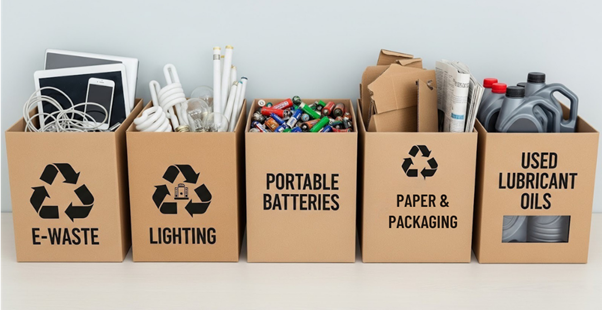
The New Year is a natural point for households and small home offices to declutter and reset routines. To keep that reset genuinely sustainable, it helps to sort what you are discarding into eWASA’s five EPR waste streams. This way, each material goes to the correct, compliant route: Electrical & Electronic Equipment (EEE), Lighting Equipment, Paper & Packaging Products, Portable Batteries, and Lubricant Oils.
What follows is a practical Audit you can run in under an hour, with the key do’s and don’ts for each stream.
Step 1: Do a “Waste-stream audit” (15 minutes)
Create five temporary piles or boxes, labelled:
- EEE (electronics): phones, laptops, printers, kettles, cables, routers, small appliances, hairdryers, used vapes, power banks, remotes.
- Lighting equipment: CFLs, fluorescent tubes, certain LED products and fixtures, bulbs removed during replacements.
- Portable batteries: AA/AAA, button batteries, vape batteries, rechargeable packs from small devices (where removable).
- Paper & packaging: cardboard boxes, paper bags, paper wrapping, polystyrene, PET bottles, label liner paper, multi-layered plastics, rigid plastic containers, metal cans, glass bottles/jars (as accepted in your area).
- Lubricant oils: used motor oil, lubricants from DIY maintenance, oil containers, and oil-soaked items (e.g., rags) that require careful handling.
This immediately reduces confusion and prevents the most common error: mixing hazardous or specialist items into general household recycling.
Stream 1: Electrical & Electronic Equipment (EEE)
Step 2: Reuse first, recycle second
For working electronics, prioritise reuse: repair, donate responsibly, resell, or trade-in. This is the highest-impact option because it avoids the footprint of manufacturing a replacement.
Step 3: Secure your data before it leaves your home
Before donation or recycling:
- Back up what you need.
- Sign out of accounts.
- Remove SIM/SD cards.
- Use factory reset and, where possible, secure wipe tools.
Step 4: Use compliant collection routes
Broken or end-of-life electronics should go to authorised drop-off points or compliant collectors, not into household bins. This supports safe dismantling, recovery of valuable metals/plastics, and responsible handling of hazardous fractions. See the map at the bottom of our homepage for a collection point near you.
Stream 2: Lighting equipment
Lighting waste is frequently underestimated. Certain lamps can contain substances that require controlled handling.
Best practice
- Do not crush or break bulbs/tubes.
- Keep lamps intact and store them in a sturdy box.
- Use appropriate collection pathways for lighting equipment rather than general recycling. Selected retailers have bins for lamps. Ask if the store near you does not offer the option.
This is a high-leverage action because mishandled lighting can contaminate otherwise recyclable materials.
Stream 3: Portable batteries
Portable batteries are small but high-risk if stored or discarded incorrectly, especially when loose in a drawer or bin.
Best practice
- Collect loose batteries in a dedicated, non-metal container.
- If you have lithium-based batteries (including many rechargeables and power banks), avoid storing them where they can be crushed or exposed to heat.
- Where practical, tape terminals to reduce the risk of short-circuiting during storage and transport.
- Do not place batteries in household bins; route them to appropriate collection systems. Find bins at retailers in your area.
Stream 4: Paper & packaging (and doing recycling properly)
New Year clean-ups often generate a surge of boxes, wrapping, and pantry packaging. This is where households can most directly improve outcomes by focusing on quality.
To reduce the amount of packaging going forward
- Consolidate purchases where possible and avoid automatic extras (cutlery, sachets, samples).
- Choose refills, concentrates, or minimal packaging options.
To improve recycling quality now
- Flatten and keep cardboard dry (wet paper/cardboard loses recyclability).
- Empty and lightly rinse containers where feasible to reduce contamination.
- Separate materials by type where your local system requires it.
This is where “reduce, reuse and recycle” becomes operational: reduce what you bring home, reuse what you can (boxes for storage or returns), and then sort cleanly so facilities can recycle materials effectively. Done well, this also supports plastic recycling by reducing contamination that can downgrade or reject loads.
Stream 5: Lubricant oils
Used lubricating oils are environmentally harmful when poured into drains, onto soil, or placed in general waste. New Year DIY car maintenance, garden equipment servicing, or generator upkeep can generate oil waste that must be handled correctly.
Best practice
- Store used oil in a sealed, clearly labelled container (ideally the original container).
- Keep it away from children, pets, and heat sources.
- Do not mix used oil with other liquids (paint, solvents, water), as mixing can complicate recovery and safe processing.
- Use designated collection mechanisms for used oil and related materials rather than general disposal.
A simple habit that makes the system work
A useful household rule is: if you are unsure, do not guess. Set the item aside and confirm the correct route via your municipality, retailer take-back, or an approved collection partner. This reduces contamination, supports compliant processing, and strengthens the EPR system outcomes across all five streams.

